Permaculture Immersion Week
Course Details
Step into a transformative week of learning, connection, and inspiration at Coed Hills. This immersive experience distills the first 60% of a full Permaculture Design Certificate (PDC) into a rich, hands-on journey focused on one powerful question:
How do you want to design your life and the world around you?
Whether you’re dreaming of a land-based project, a more sustainable lifestyle, or simply a healthier, more resilient way of living, this course gives you the tools, confidence, and community to begin.
What You’ll Experience
Over seven nourishing days, you’ll explore the foundations of permaculture through a dynamic blend of:
- Practical, hands-on learning in gardens, woodland and land-based systems
- Interactive design sessions focused on your own life or project
- Wellbeing and somatic practices to support personal resilience
- Group co-coaching and reflection to deepen learning and integration
- Connection with nature as a guide for regenerative design
Each day weaves together theory, practice, and personal insight—helping you move from ideas into action.
What You’ll Learn
Put yourself at the centre of your design process:
- Whole health, nutrition and wellbeing
- Personal resilience and sustainable lifestyle choices
- Clarifying your values, your vision and your practical next steps
Sustainable Living & Ecological Design
Understand the core principles that underpin regenerative systems:
- Permaculture ethics and design frameworks
- Patterns in nature and how to apply them
- Energy-efficient planning (zones, sectors, input/output thinking)
Food Growing & Ediculture
Reconnect with food as culture, ecology, and nourishment:
- Organic horticulture and soil health
- Forest gardening and polycultures
- Seasonal awareness, foraging, and food systems
Practical Skills & Tools
Learn by doing:
- Site observation and land-based design
- Mapping, surveying, and design techniques
- Working with real projects in collaborative design exercises
Community & Resilience
Explore how we thrive together:
- Communication and co-operation skills
- Local resilience and community systems
- Pathways to regenerative livelihoods and projects
A Unique Learning Experience
This is a hands-on, immersive week.
With yoga in the mornings, time in nature, shared meals and evening conversations, it supports your whole self, mind, body and spirit. Rather than just learning the ideas, you’ll experience what they look and feel like in practice.
What You’ll Leave With
By the end of the week, you will have:
- A clearer vision for your life or project
- Practical tools to begin designing and implementing it
- Increased confidence in growing food and living sustainably
- A deeper sense of connection to yourself, to others and to nature
- Inspiration and momentum to continue your journey
Who Is This For?
This immersion is perfect if you:
- Want a powerful introduction to permaculture
- Are considering a full PDC and want to get started
- Have a project, idea, or lifestyle shift you want to explore
- Care about health, wellbeing, sustainability, and resilience
- Learn best through hands-on, experiential environments
Taking Your Learning Further
If you want to take your learning further after this course, to go deeper into your permaculture learning, and to take your main design project further with support, then you will have the choice to complete a further 5 day course with the Coed Hills-A Wild Life team later in 2026 or in 2027 to gain your Permaculture Design Certificate (PDC), certified by the Permaculture Association (Britain). You will also have the option to complete modules with other teachers to complete your PDC, as part of the new modular PDC system overseen by the Permaculture Association (Britain).
Ready to Begin?
This week could be the turning point where ideas become reality.
Book your place now and start your journey into permaculture living.
Learn more about Permaculture >
The Venue
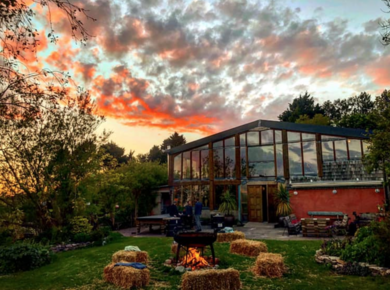
Hosted at Coed Hills, an inspiring eco-community, rural arts space and centre for low impact living established for over 20 years, the course will provide a depth and breadth of learning experiences that are rarely available. Through the course you will be immersed in an experience of low impact living in a beautiful, productive and nurturing environment. Nestled in a lush, rolling rural landscape in the Vale of Glamorgan, about 8 miles west of Cardiff, near the village of St Hilary, Coed Hills features:
- One of the most mature, diverse, productive and beautiful forest gardens in Britain – over 100 species, including over 150 varieties of apples & pears;
- A micro market garden serving the communities needs as well as events and locals;
- Multiple cabins and low impact dwellings;
- Multiple compost toilets, shower block, sauna and single-person cold plunge pool!
- Many acres of communal grounds, a stone circle and beautiful views across the Bristol Channel as far as North Devon.
Visit the gallery to see just how beautiful Coed Hills actually is >
The overall course programme features:
- Residential session at Coed Hills: Thursday 7th May – Wednesday 13th May,
- Delicious organic food and shared meals, with hands-on learning for creation of healthy, nutritious meals that taste fantastic.
- Aspects of the Ediculture curriculum (edible-culture for short): Ediculture incorporates food growing, wild foods, edible landscaping & forest gardening, seasonal awareness, nutrition, herbs, working with others and nature connection, and integrates perfectly into the PDC curriculum.
- Somatics & Whole-System Ecology (with Gemma Mallol) – this strand brings the body into the learning process. Through somatic practices of movement, sensing and grounding outdoors, participants explore how the body is part of nature and the wider web of life. This approach supports resilience, helps integrate change, and links Zone 00 (self) with food, land, community and culture — a whole-system journey of inner and outer regeneration. Learn more >
- Social Permaculture – explores the vital role of communication, relationships and collective working, the balance between individual and collective responsibility, and practical tools for transformation in these areas;
- Holistic health, wellbeing and resilience (individual and collective) – the course incorporates a strong focus on design and creation of health-creating lifestyles, and how to enjoy delicious healthy ultra-low impact meals and food choices;
- A supported process for designing your own project;
- Co-coaching: The essentials of co-coaching for permaculture and life transformation – the course will establish support groups (‘guilds’) amongst the participants and include 2 online co-coaching calls after the course for all participants, to support you on your next steps beyond the course;
- Onsite free camping, or a choice of cozy cabin or yurt accommodation (additional cost);
- An optional follow-on – complete the course
The course team includes:
- Steve Charter (Pc Diploma, 2001) – Steve has led numerous PDC’s in the UK and Spain, has deep knowledge of mainstream and grassroots sustainability (particularly sustainable construction), lived off-grid in southern Spain for 5 years, is a long-term member of the permaculture Education Working Group (which oversees and evolves the PDC curriculum), works for the Permaculture Association 2 days/wk, including as UK lead for the Community Climate Coaches programme; practicing coaching for permaculture & sustainability; new Art of Hosting practitioner; author of Eat More Raw (Permanent Publications, 2005); father of an 19 year old son.
- Stevie Watts – Stevie leads the Ediculture programme, Ediculture charity, the forest garden and community market garden at Coed Hills, and is lead coordinator for Coed Ffest. Stevie is also a musician and sculptor, has a passion for and strong connections with rural communities and musicians in Zimbabwe, and lives in a self-build tiny house at Coed Hills; father of a new baby girl.
- Gemma Mallol – practitioner and researcher in somatic ecology. Gemma’s work explores the body as part of nature and uses simple outdoor practices to build regulation, resilience and connection. She helps participants weave learning across inner and outer systems so changes in the garden and community are embodied and durable.
- Mathu Bloom – has lived at Coed Hills for almost eight years, in a tiny house she designed and built herself, and works closely with Stevie to maintain the gardens. She grows vegetables for the community, prepares salads for events, and cultivates flowers to decorate shared spaces. Originally from the Netherlands, Mathu was shaped by many years of travel before settling at Coed Hills. During the course, she will offer practical support wherever needed and share seasonal, place-based learnings gained through everyday life at Coed.
- Marianne Lindfield – Marianne has a strong background in community engagement and led the design and development of The Pod Project in Northern Ireland, a local permaculture and wellbeing hub, that delivered an integrated annual programme incorporating a PDC within a wider personal and community wellbeing programme; Marianne is a Yin Yoga and Embodied Permaculture and works for Sussex Greener Living CIC; mother of 2 teenage daughters.
Why this course is unique
While many Permaculture Design courses focus on design and social permaculture, this course brings together design thinking, community learning, in-depth food growing skills and embodied practice: it’s balance between design and practice is unique. It weaves land, food systems and social ecology with the lived experience of the body, recognising that sustainable design is not only something we plan and analyse, but something we feel, practise and live.
- Ediculture grounds participants in the rhythms of food, soil, plants and seasons.
Learn more > - Somatics & Whole-System Ecology allows those rhythms to be experienced directly in the body, treating the body as nature and as part of the web of life.
Learn more > - Social permaculture strengthens the relationships and systems that carry learning into community life.
- Holistic wellbeing provides tools for lifestyle change, resilience and health.
- Coaching to support individual aspirations and progressing with permaculture and regenerative life change beyond the course.
By linking Zone 00 (self) with land, food and community, this course offers a genuinely whole-system learning journey.

If you’d like to explore the thinking behind our approach to learning, community and care, you might enjoy our reflection Why a Wild Life?
The Cost
We offer three tiers of pricing, based on an honesty policy. This approach helps make the course accessible to people in different financial situations, while also ensuring we can cover costs and run the course again in future.
- £350 – Low income / unwaged
A limited number of places are available at this rate for those who would otherwise be unable to take part. - £475– Standard rate
This reflects the true cost of running the course. - £700 – Feeling generous
Choosing this rate helps subsidise lower-income places and supports the long-term sustainability of the course.
We ask participants to choose the tier that best reflects their circumstances, trusting that this shared responsibility supports both individual access and the wider learning community.
Payment plans can also be arranged, please get in touch if this would support your participation.
The Accommodation
Onsite free camping with access to compost toilets, solar showers, washing up facilities, tea and coffee making.
As an optional alternative to camping at affordable additional cost, individual accommodation spaces are dotted throughout the gardens. These can be booked for private comfort and quiet rest, or shared by groups.
What we have on offer:
- The Dragon Wagon has 1 double, a wood burner and incredible views over the fields. £100 per course week.
- The cosy Woody has 1 double, a wood burner and feels very protective with a huge window to dream away. £100 per course week.
- The Railway Carriage has 1 double and 2 singles in the form of a bunk bed. It has an electric heater and is constructed from…. a railway carriage with a cob extension. Disabled Access. £100 per course week.
- The cheerful McGhee Mansion has 1 double in a loft and 2 singles, a wood burner and a fully equipped kitchenette. £120 per course week.
- The red Anastasia yurt has 5 singles all around, a wood burner and lots of space. £120 per course week.
- The funky Rock, Bull, Crane and Black Sail pods all have 2 singles and electric blankets. £80 per course week.
- The Ball of String Pod has 1 double and electric blankets. £80 per course week.
- Dawn & Dusk, Ying & Yang and Sol & Luna. On the other side of the labyrinth we have 3 pods divided in 2 single sleeping spaces.These rooms are compact, with a single bed and an electric heater. £60 per course week.
- The Farmhouse– we have three rooms in the farmhouse. This house has central heating and a shared bathroom with a toilet.
- The Grand Room has incredible views and two massive single beds. £120 per course week
- Rawley’s Old Room has 1 double bed and lots of space. £100 per course week
- The Little Back Room has 1 tiny double and it’s own sink. £80 per course week
For more details about the accommodation please contact Mathu by email: communitycoed@gmail.com
Accessibility & inclusion
We aim to make this course as inclusive and accessible as possible. One of our accommodation options, the railway carriage, is wheelchair accessible. The main teaching space in the barn is also wheelchair accessible, and there is an accessible toilet located there.
If you have access needs or questions not covered here, we warmly encourage you to get in touch before booking. We are happy to discuss what is possible and how we can best support your participation.